Music Triads and chord symbols
The quality of a triad is determined by the precise arrangement of its intervals. Tertian trichords, known as triads, can be described as a series of three notes. The first element is called the root note of the chord, the second note is called the “third” of the chord, and the last note is called the “fifth” of the chord. These are described below:
| Chord names | Component intervals | Examples | Chord symbols | |
| major triad | major 3th | perfect fifth | C-E-G | C, CM, C ma, C maj |
| minor tr. | minor third | perfect 5th | C-Eb-G | Cm, C mi, C min |
| augmented triad | major 3th | augmented fifth | C-E-G# | C +, C +, C aug |
| diminished tr. | minor third | diminished 5th | C-Eb-Gb | C m(b5), C dim |
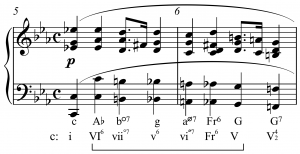
Inversions and chord positions : symbols
When the bass note is not the same as the root note, the chord is said to be inverted.
The number of inversions that a chord can have is one less than the number of chord members it contains. Triads, for example, (having three chord members) can have three positions, two of which are inversions:
- Root position: The root note is in the bass, and above that are the third and the fifth. In the first scale degree this is marked ‘I’
- First inversion: The third is in the bass, and above it are the fifth and the root. This creates an interval of a sixth and a third above the bass note, and so is marked in figured Roman notation as ‘6/3’. This is commonly abbreviated to ‘6’ (or ‘Ib’) since the sixth is the characteristic interval of the inversion, and so always implies ‘6/3’.
- Second inversion: The fifth is in the bass, and above it are the root and the third. This creates an interval of a sixth and a fourth above the bass note, and so is marked as ‘6/4’ or ‘Ic’. Second inversion is the most unstable chord position.
- Inverted triads :the first three chords played are C major root position, first inversion, second invers.; then C minor root position, first inversion, second inv..